
Glass Roman Lamps – inventory
Glass Roman Lamps – inventory
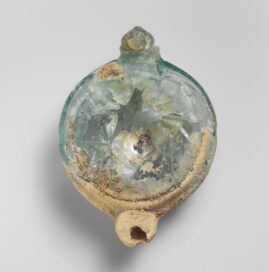
1/ Metropolitan Museum Accession Number: 74.51.286
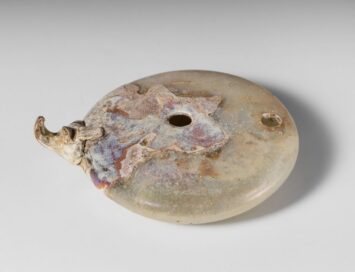
2/ Metropolitan Museum Accession Number: 91.1.1513
Catalogue
Nr. 1: MMA Number: 74.51.286
Year of discovery: 1874–76
Archaeological context: unknown
Proposed dating: ca. 2nd half of 1st century A.D.
Contextual dating: unknown
Characteristics and dimensions: Glass; blown in a closed mold; Translucent blue green; applied trail in same color. 1 1/2 × 4 3/8 × 3 1/8 in. (3.8 × 11.1 × 8 cm)
Suggested manufacturing location: Regional product, possibly an experiment.
Main Characteristics: Projecting oval nozzle with wick hole; circular body with sloping, slightly concave shoulder, separated from the discus by a single groove; plain discus, deeply pressed in at center; raised outer flange below shoulder, then sides curving in to rounded base with deeply pressed-in center; integral projecting oval boss at rear, opposite nozzle, to which a solid, thick trail has been applied to form a handle. Broken and repaired, with part of discus missing and weathered breaks on nozzle and handle; many bubbles; slight dulling and iridescence, with patches of thick, yellow limy weathering, especially at front of body and on nozzle, and smaller areas of soil encrustation. No filler hole is visible but must have been located towards rear of discus behind the central point where the discus and bottom have been pressed together.
Nr. 2: MMA Number: 91.1.1513
Year of discovery: 1891
Archaeological context: unknown
Proposed dating: 2nd–3rd century A.D.
Contextual dating: unknown
Characteristics and dimensions: Glass; blown; colorless, with handle of same glass. H.: 1/2 in. (1.3 cm) Diam.: 2 1/4 in. (5.7 cm)
Suggested manufacturing location: Regional product.
Main Characteristics: Horiziontal rounded inward lip to small central mouth; almost flat top to lentoid body with rounded side, then curving in to pushed-in bottom with large oval pontil scar; ring handle applied as a large pad to side and trailed off on top. Small hole cut in top near edge opposite handle, forming nozzle for wick. Body complete, but handle broken and most of ring missing; many pinprick bubbles; dulling, pitting, iridescence, and patches of thick creamy weathering.