
Roman Glass Lamps
Glass Roman Lamps
Glass and lamps – seems to us like a pretty obvious connection. However, most of the Ancient world would disagree. Most Ancient Roman lamps were made from clay and terracotta, with an extremely small number of glass lamps. What did they look like, where were they made and why were they made?
When talking about lamps from ancient times, we can easily find examples from all over the Mediterranean area. Most of them are made from clay or terracota, but we can also find examples from other materials. The glass lamps are quite rare, but also fascinating, and we can still find such lamps in the Roman Empire.
The rarity of glass lamps can be seen in Pompeii – from 2000 glass findings, only three lamps were found (~0.15% of all findings). This topic is definitely difficult and not well-researched for now – only a few publications has been made so far, often with limited finds, making it almost impossible to form any evident conclusions.
But what can we qualify as ‘glass lamp’? According to Lightfoot, glass lamps are the ones that possess the same functional parts as the clay ones. In his research, he noticed that some glass artifacts are sometimes mistaken for lamps. Although they range in shapes, they almost always have a vertical cylindrical body with a folded horizontal flange at the top and bottom. Although often called lamps or inkwells, they might have as well been simply glass containers with completely different functionality. Therefore, it is hard to assume their real purpose, and claiming they are lamps would be too far-fetched, especially when some do not have a second hole or nozzle for the wick. What’s more, the proximity of the flame to the wick nozzle may have caused the glass to very easily crack.
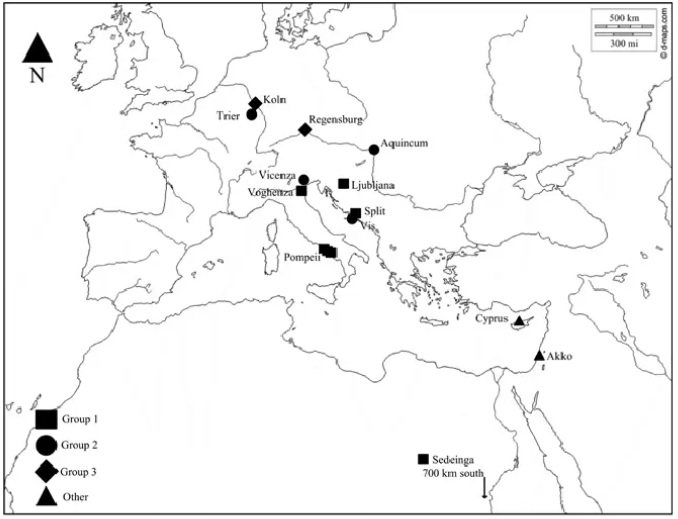
Fig 1. Distribution of Roman glass lamps, map by Luca Arioli
Most of the glass lamps discussed here are from the western part of the Roman Empire and are distributed across Italy, Dalmatia and along the Rhine and Danube frontiers. We also have finds from Vis and Split, as well as from Germany – from Koln and Trier. Some other lamps were found in the Eastern Mediterranean, on Cyprus and even in the territory of modern Israel. One lamp in Sedeinga (Sudan) is a result of long-distance trade. Almost all of them were found in a funerary context, but only a few could be dated, based on pottery association, to around 1st to 2nd century AD. The fact that they are rare in settlement sites could be due to glass often being fragmentary there, meaning that if lamp fragments were found in a settlement, it is unlikely that they would be correctly identified and attributed.
Due to the small numbers of findings, it is hard to pinpoint a precise place of creation, except that they were made in the western glass-working centers. Italy and Adriatic coast contains the most findings, which is not surprising – glass-working activities are well documented in that area in the Imperial times. We have important glass-making centers in Aquileia, Campania and Puteoli. The lamps in Germany can be attributed to manufactures of Rhineland, and we can make an assumption that glass-makers from the Near Eastern coast would be responsible for the development of the mould-blowing technique. The lamp from Cyprus can be considered an experimental local product.
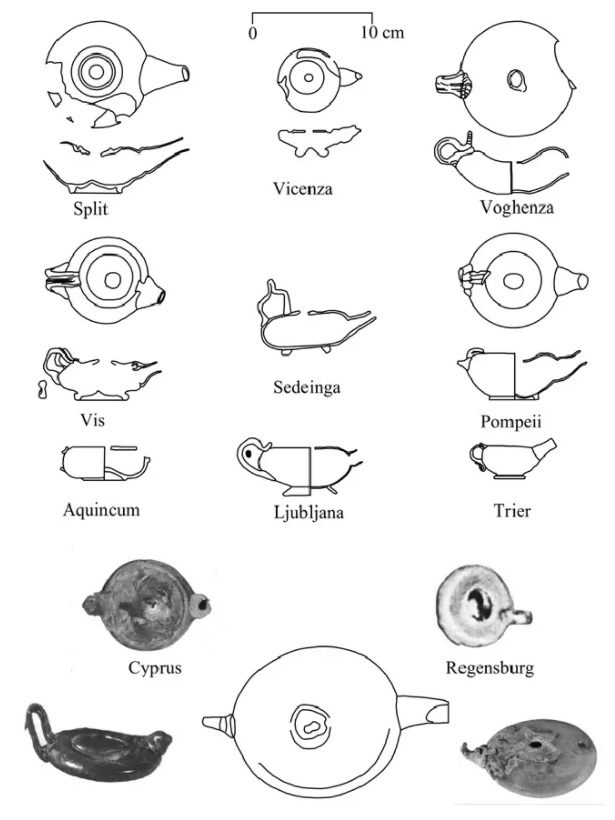
Fig 2. Roman glass lamps, drawings by Luca Arioli
The lamps were made using a free-blowing technique. The process of free-blowing involves the blowing of short puffs of air into a molten portion of glass (a ‘gather’) which has been spooled at one end of the blowpipe. All the lamps have a round body with a central filling hole and an applied, usually raised nozzle. Handle and base-ring is common, but not always present. Additionally, almost all of them are made from naturally colored glass, with the exception of one dark-green lamp from Vicenza. Although some researchers suggested typology for glass lamps, it seems hard to establish a strict typology on such a small number of finds – after all, each specimen modeled through free-blowing is unique. Luca Arioli suggests splitting them into three loose groups. Group 1, a most common group, contains lamps with high, curved shoulders. Group 2 are lamps with the topside flattened at nozzle level. After blowing, they were crafted in order to have a completely flattened upper part. Although quite plain, some have decorative circles similar to clay lamps. Lamps from Group 3 have round, squeezed and enlarged bodies with a very large central filling-hole, flat nozzle and no handle, and are common in finds from Germany. Still, there are singular lamps with no similar features, for example the lamp from Cyprus that was blown into a clay mold.
To sum up, the rarity of the lamps can be attributed to possible misidentification at settlement sites, but also impracticality. Glass lamps are harder to make and take more time to produce. They are simply not as efficient as clay lamps. Additionally, the glass can start cracking when exposed to high temperature – which could even be hazardous to the owner. Still, we have evidence they existed and were used. Experimentation and exchange with other productions, as well as creation of new forms and types are common aspects of prolific productions. It is likely that when glass started being easily worked to create common-use objects, the glass-workers experimented with transposing a popular and common oil lamp. Given the distribution of finds and their geographical relation with industrial centers and regions, it is likely that glass-makers operating in different areas created glass lamps independently from their colleagues, trying to diversify their production by designing new glass objects, to expand their trade – but glass lamps clearly proved unsuccessful.