
Photos and basic inventory card
Photos and basic inventory cards
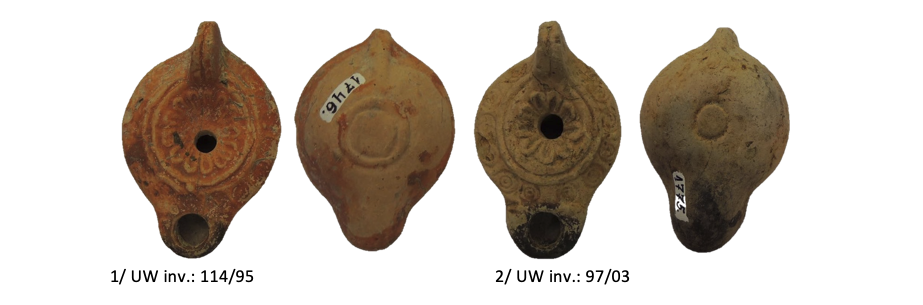
CATALOGUE
N1: UW inv. 114/95; Shvishtov Museum: inv. 1746
Year of discovery: 1995
Archaeological context: lamp unearthed in the floor of room 45 of the valetudinarium.
Proposed dating: early 2nd century A.D.
Contextual dating: period VI/1a: 101-121 AD.
Characteristics and dimensions: clay: light orange with inclusions; slip: dark orange; l: 7.74; w: 5.30; h: 2.65; h (a): 3.83.
Suggested manufacturing location: Regional production.
Main characteristics: over-molded lamp of good quality although some elements (blurred decorations on the shoulder, filling hole off-center in relation to the rosette) show some negligence in its manufacture. Discus decorated with a rosette and defined by a double rim in relief with, in the middle, an incised circle. Shoulder decorated with printed discuses. Molded handle, striated but not pierced. Base decorated with a circular rim defined on each side by a concentric incision. Traces of combustion. This specimen is a kind of prelude to the following lamps and their general morphology. Its rosette as well as the mark on the base are nevertheless more elaborate and, especially, the nozzle is not separated from the shoulder with an impressed line.
N2: UW inv. 97/03; Shvishtov Museum inv. 1775
Year of discovery: 2003
Archaeological context: unknown
Proposed dating: early 2nd century A.D.
Contextual dating: unknown
Characteristics and dimensions: clay: hazelnut; slip: traces of dark orange slip; l: 8.57; W: 5.50; h: 2.87; H (a): 4.11.
Suggested manufacturing location: Regional production.
Main characteristics: good quality lamp with a wide, slightly raised nozzle. Discus decorated with a rosette and defined by a rim and an incised circle. Shoulder decorated with printed discuses. Nozzle defined by a horizontal line in relief. Molded handle, striated but not pierced. Base decorated with an incised circle. Traces of combustion.
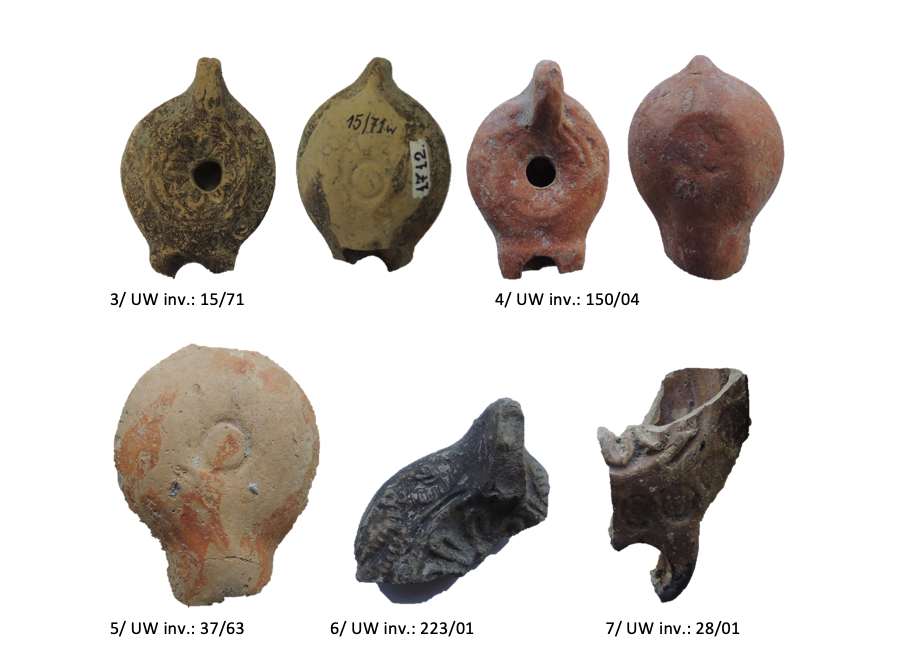
N3: UW inv: 15/71; Shvishtov Museum: inv. 1712
Year of discovery: 1971
Archaeological context: lamp unearthed near the south wall of room 69/70 – below the sinking of the window.
Proposed dating: early 2nd century A.D.
Contextual dating: period VI/1a: 101-121 AD.
Characteristics and dimensions: clay: beige; slip: dark brown, poorly distributed; W: 7.11(max); L: 5.37; H: 2.80; H (a): 3.90.
Suggested manufacturing location: Regional production.
Main characteristics: lamp of good quality in all points identical to the previous one; wide nozzle slightly raised, its end being lost. Discus decorated with a rosette and defined by a rim and an incised circle. Shoulder decorated with printed discuses. Nozzle defined by a horizontal line in relief. Molded handle, striated but not pierced. Base decorated with an incised circle. Traces of combustion.
N4: UW inv: 150/04
Year of discovery: 2004
Archaeological context: lamp unearthed in the floor of room 67 of the valetudinarium.
Proposed dating: early 2nd century A.D.
Contextual dating: period VI/1a: 101-121 AD.
Characteristics and dimensions: clay: light orange with some inclusions; slip: dark orange; W: 7.03 (max); L: 4.97; H: 2.54; H (a): 3.64.
Suggested manufacturing location: Regional production.
Main characteristics: exemplary in all points identical to the previous ones, but with a much more neglected quality. Wide raised nozzle, separated from the shoulder by a line; its end is lost. Discus decorated with a rosette and defined by a rim and an incised circle. Shoulder decorated with printed discuses. Nozzle defined by a horizontal line in relief. Molded handle, striated but not pierced. Base decorated with an incised circle. Traces of combustion.
N5: UW inv: 37/63
Year of discovery: 1963
Archaeological context: unknown.
Proposed dating: early 2nd century A.D.
Contextual dating: unknown.
Characteristics and dimensions: clay: light orange with many inclusions; slip: dark orange, badly distributed; l: 6.65 (max).
Suggested manufacturing location: Regional production.
Main characteristics: base of a lamp in all points identical to the previous one.
N6: UW inv. 223/01
Year of discovery: 2001
Archaeological context: Lamp uncovered in the southern corridor of the valetudinarium.
Proposed dating: early 2nd century A.D.
Contextual dating: period VI/1a: 101-121 AD.
Characteristics and dimensions: clay: light beige with some inclusions; slip: very dark brown; l: 4.19 (max).
Suggested manufacturing location: Regional production.
Main features: Rear part of a well-made over-molded lamp. Discus decorated with a rosette with four double petals defined by a double bead in relief. Shoulder decorated with a rope-shaped pattern, in continuous wave, hatched. Handle molded, but not pierced.
N7: UW inv: 28/01
Year of discovery: 2001
Archaeological context: Lamp unearthed in the floor of room 93 of the valetudinarium.
Proposed dating: first third of the 3rd century A.D.
Contextual dating: Period VI/2: AD 222-238.
Characteristics and dimensions: clay: yellowish beige with many inclusions; slip: dark orange to brown; l: 5.44 (max); h: 2.34.
Suggested manufacturing location: Regional production.
Main characteristics: front part of a lamp similar to the previous ones, with a wide raised nozzle, separated from the medallion a line of printed pointed discs. Discus decorated with a rosette of eight petals, defined by a circular groove in relief. Shoulder decorated with printed discuses. Traces of combustion.